
Tambour Doors in Furniture: Why This Old Mechanism Still Works
The most interesting part of a cabinet can disappear inside it.
Pull a tambour door to one side and the solid front begins to bend. What looked like one surface travels around a curve and slips into the body of the furniture, leaving the cabinet open without a door projecting into the room.
It is a very old idea. It is also a very good one.
Tambour doors have appeared on desks and cabinets for centuries, yet the mechanism still feels surprising when you use it. Perhaps that is because most furniture tries to hide how it works. A tambour makes movement part of the experience.
What is a tambour door?
A tambour door is made from a series of narrow slats joined so that they can move as one flexible surface. The slats run in a track and follow a curve into the side or back of a cabinet when the door opens.
Traditional versions commonly use wooden slats fixed to a flexible backing. Other systems connect or guide the individual slats in different ways. The principle remains the same: a surface that is firm when closed but flexible enough to travel around a corner.
The best-known example is probably the roll-top desk. Close it and the curved shutter covers the writing surface. Open it and the shutter disappears into the desk rather than swinging outwards.
On a sideboard, the movement is often horizontal. Two doors may meet at the centre, then travel away from one another and into the cabinet.
Why use tambour doors on a sideboard?
The first reason is practical. A normal hinged door needs clear space in front of the cabinet. A wide pair of doors can interrupt a walkway, meet a dining chair or make a sideboard difficult to use in a tighter room.
A tambour door stays within the footprint of the furniture. Nothing swings into the room.
It can also provide better access than ordinary sliding doors. With a pair of flat sliding doors, one section of the cabinet often remains covered by the other. Tambour doors can move out of sight, revealing the interior more completely.
Then there is the movement itself.
Opening a well-made tambour is satisfying. The door follows the cabinet rather than detaching from it, and the object changes character as it opens. A closed sideboard can appear calm and complete; open it, and the working interior takes over.
Tambour doors, hinged doors and sliding doors
No door system is automatically better. The right choice depends on the room and what the cabinet needs to do.
Hinged doors are direct and familiar. They can open wide and are relatively simple to understand, but they need space in front of the cabinet.
Flat sliding doors save that floor space. Their disadvantage is that one door usually passes behind another, so the whole interior is not visible at once.
Pocket doors can disappear into the cabinet, but the pockets take up internal width and the doors still need a straight route.
Tambour doors combine compact opening with a surface that can follow a curve. They are particularly useful when the movement is part of the design rather than something to conceal.
That freedom comes at a price: they are far less forgiving to make.
Why are tambour doors difficult to make well?
A tambour may look simple because the slats repeat. In practice, every small piece affects the movement of the whole door.
The width of each slat has to suit the curve. Wider slats create a calmer surface but cannot follow a tight turn. Narrower slats bend more easily, yet introduce more joints and more opportunities for small inaccuracies.
The track must be precise. If it narrows, changes direction abruptly or falls out of alignment, the door can drag. The weight of the surface matters too, especially when decorative veneers or inlays are added.
Most importantly, the mechanism has to work after the cabinet leaves the workshop. Furniture lives with dust, changes in temperature and thousands of repeated movements. A door that glides beautifully for a photograph but catches in daily use is not a successful piece of design.
Good tambour furniture depends on the parts you do not immediately notice: the track, the bearings or backing, the curve inside the cabinet and the tolerances between all those moving slats.
A moving surface changes the design
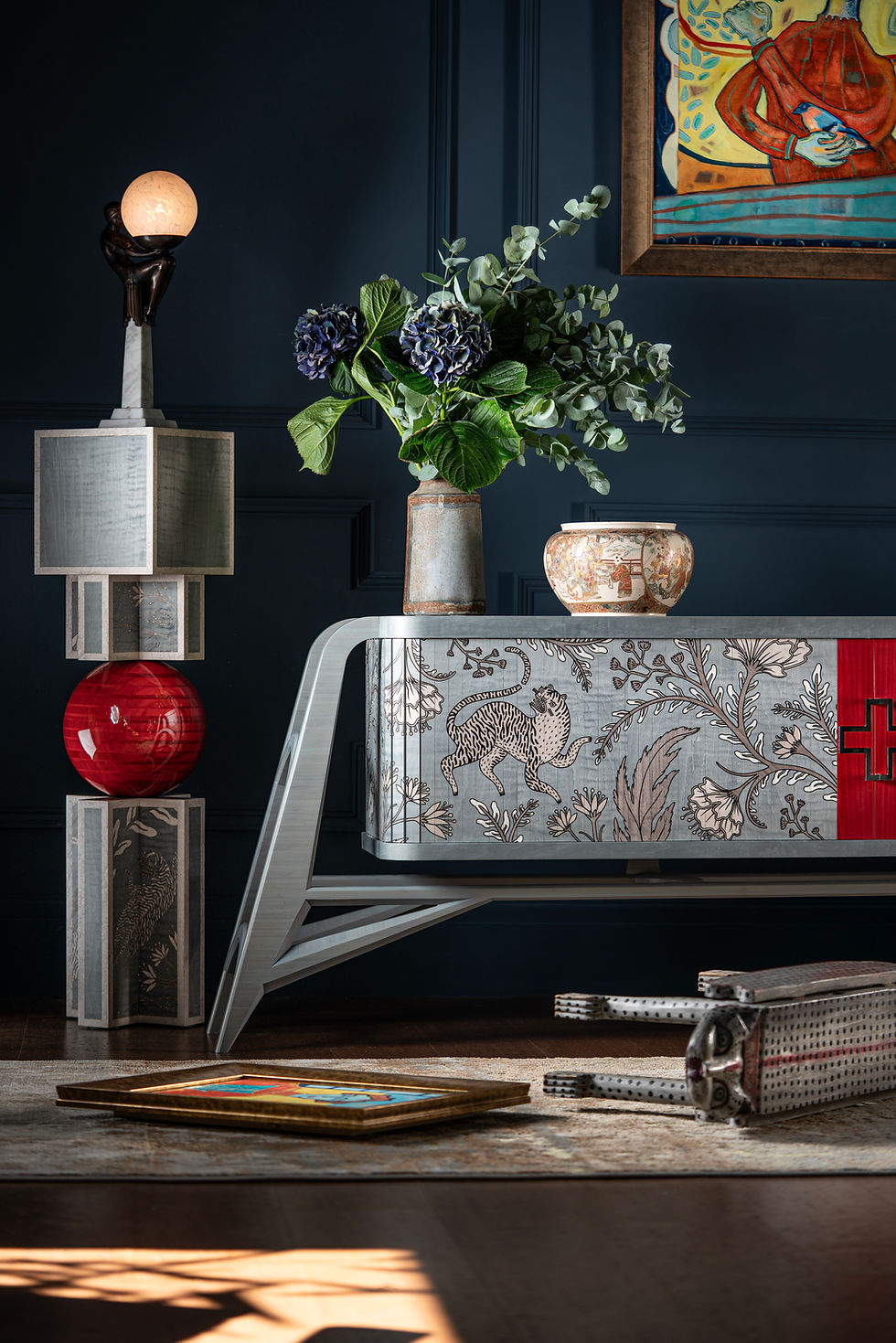
Tambour doors are often treated as a texture. The repeated vertical lines give a cabinet rhythm, even when the timber and finish are restrained.
But the slats can carry far more than a simple grain.
Pattern introduces a difficult question: what happens to an image when the surface beneath it moves?
When the doors are closed, the design should read across the front of the cabinet. As they open, the same image breaks into narrow sections, bends around the sides and gradually disappears. The pattern is no longer only something you look at. It becomes part of the action of opening the piece.
For us, this was the most interesting reason to use the mechanism.
The Panthera tambour sideboard

On the Panthera Sideboard, marquetry runs across the tambour doors rather than sitting on a single flat panel.
Each slat forms one narrow part of a larger botanical scene. Figured sycamore, figured eucalyptus, Madrona burl, tulip veneer and mother-of-pearl create the pattern across the front. A mythical tiger appears among the leaves.
The difficulty is not simply cutting the marquetry. The image has to remain coherent across hundreds of separate pieces while every slat retains its ability to move.
When the doors open, they glide around the body of the sideboard towards the back. Metal bearings support the movement. The cabinet can therefore be viewed from different positions in a room without open doors projecting from its sides.
Inside, red drawers and storage sit behind the pale opal-toned exterior. Closed, the furniture is led by the marquetry. Open, the colour and function of the interior become visible.

The mechanism is not an addition to the design. It is the reason the design behaves as it does.
What should you look for in a tambour cabinet?
Begin by opening it.
The door should move evenly through the full track. It should not need a sharp tug to begin, race through one section or catch as it travels around the curve.
Look at the meeting point when the doors are closed. The gap should feel intentional and the slats should sit consistently. If the front carries a veneer or pattern, check how it crosses each joint.
Then consider the cabinet open. Can you reach the storage easily? Do the doors disappear far enough to make the interior useful? Has so much space been given to the mechanism that the cabinet no longer holds what you need?
Useful questions include:
• How are the slats connected or supported?
• What guides the door through the cabinet?
• Can the track or moving parts be reached for maintenance?
• How should the door be cleaned?
• Has the finish been chosen for a moving surface?
• What happens if one slat is damaged?
A beautiful front matters. So does being able to use it without holding your breath.
Are tambour sideboards suitable for small rooms?

They can be, because the doors do not require opening space in front or beside the cabinet. This can make a tambour sideboard useful in a dining room where chairs sit nearby or in a narrow route through a living space.
The overall proportions still matter. A cabinet that is too deep, too high or visually too heavy will not become right for the room simply because its doors slide away.
Measure the furniture closed, then think about how you will stand and move while using it. The mechanism saves door clearance; it does not replace proper space planning.
How do you care for tambour doors?
Use the door by its intended handle or leading edge and move it steadily. If it begins to resist, do not force it. A small obstruction in a track is better dealt with early than driven further into the mechanism.
Keep the tracks free from loose dust using the care method supplied by the maker. Avoid adding household oils or sprays unless they are specifically recommended, as these can attract dirt or affect nearby finishes.
Decorative surfaces should be cared for according to their actual materials. Marquetry, lacquer, metal and mother-of-pearl do not all respond to the same cleaner.
With a complex piece, ask for care instructions before delivery and keep them. The mechanism should feel effortless to use, but it is still a piece of precision furniture.
An old answer to a modern room
Tambour furniture has lasted because it solves a real problem elegantly. It conceals storage, saves opening space and turns a door into a moving part of the object.
What changes is the surface.
On an old desk, the slats might form a sober curve of timber above papers and pigeonholes. On a contemporary sideboard, they can carry a tiger through a field of marquetry and make the artwork disappear as the cabinet opens.
The mechanism does not need reinventing. It needs a reason to be used.
If you are considering a sideboard for a particular room, send us a photograph or plan and tell us what it needs to hold. We can show you the Panthera Sideboard, discuss its finishes or explore whether a bespoke cabinet would suit the space better.

Comments