How Patterned Textiles Change the Feel of a Room
Updated: 4 days ago
Patterned textiles give an interior a focal point, bring separate colours into conversation and change how a surface reads from across the room. Their effect depends on the size of the motif, the contrast between its colours, the cloth itself and where you use it. More pattern is not always the answer. A better-placed pattern often is.
You can see this most clearly when a room is almost finished. The furniture fits. The walls are the right colour. Yet everything feels slightly anonymous. One patterned headboard or a generous pair of curtains can give the room something to remember.
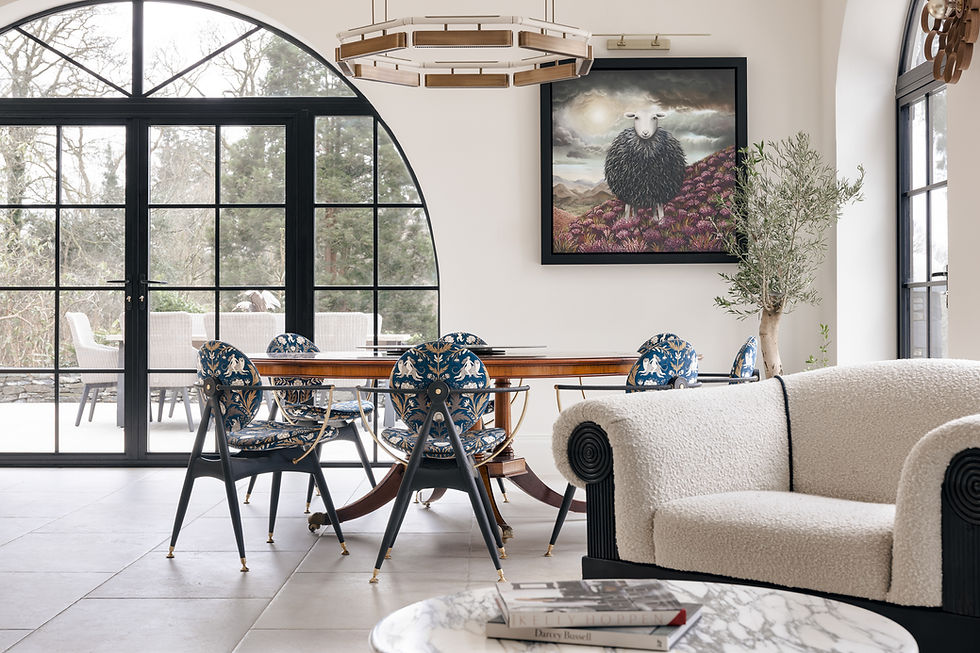
Patterned chair backs bring colour into a dining space without covering every surface.
What does pattern add that plain fabric cannot?
A patterned fabric can connect colours that otherwise look unrelated. A little warm brown in a botanical design might pick up the timber of a chair; a pale ground might sit comfortably beside the walls. The connection does not need to be exact. It needs to be visible enough to make the choices feel connected.
Pattern also directs attention. A clearly drawn animal or flower asks you to look at a particular surface. A small, closely repeated motif can read almost as texture at a distance, only revealing its drawing when you come nearer. These are different jobs. Decide which one the room needs before choosing the fabric.
There is a personal element, too. A fabric you choose because you enjoy its drawing brings more to a room than one selected only because it matches the paint. You will be looking at it for rather longer than the paint chart.
Start with the surface, then choose the scale
Lay out the dimensions of the chair back, cushion, headboard or curtain before settling on a repeat. A large motif can be lost if most of it disappears into a seam. A tiny repeat can become busy across a wide expanse, even if the sample looks restrained in your hand.
For curtains, look at the design in folds as well as flat. For upholstery, ask where the main motif will sit and how it will meet at the seams. A beautiful drawing deserves a little thought about where it gets cut.
This does not mean small rooms must have small patterns. A broad motif on one carefully chosen surface can be easier to read than several competing small prints. Test it from the doorway and from the place where you actually sit.
A real example: our Bay View bedroom
In our Bay View project, we worked with Tora Pistachio velvet, a bespoke dark-stained oak headboard, made-to-measure curtains and a blind. The pattern played different roles at the bed and the window. A smaller scale brought detail close to the headboard; the larger scale gave the drawing more room at the window.
The useful lesson is not that every room should repeat one fabric. It is that one drawing can behave differently when its scale and position change. We explain that decision in The Importance of Scale in Textile Design.

At Bay View, the upholstered headboard gives the bedside composition its focal point.
How do you mix patterns without making the room feel crowded?
Begin with the fabric you care about most. Take a colour from it into a second surface, then change the scale or the type of drawing. A flowing botanical and a simple stripe can work together because they do not ask the eye to follow the same movement.
Keep the amount of each fabric in proportion to its intended use when you lay out samples. A cushion-sized square beside a curtain-sized length tells you more than two equal swatches. Include the materials already in the room: flooring, timber, wall finishes and the upholstery you intend to keep.
Leave some surfaces plain if the room needs them. Pattern does not have to fill every available gap to feel assured.
The cloth matters as much as the drawing
The same design can look quite different on velvet, linen or a woven jacquard. Pile, texture and sheen affect the way light reaches the pattern. View a sample in daylight and under the lamps you use in the evening, turning it as you look.
Choose the cloth for its purpose as well as its appearance. Ask for the specific fabric's upholstery or curtain suitability, care information and any required performance documentation. A colourway photograph cannot tell you whether a cloth is appropriate for a heavily used seat.
If you are deciding between a woven and a printed pattern, our silk jacquard versus printed fabric guide explains the difference and offers a practical sample comparison.

Up close, the cloth is part of the design: folds, texture and sheen change how a pattern reads.
A useful way to test a textile scheme
Choose the surface that should carry the main pattern.
Check its usable dimensions, seams and folds with the person making it.
View a generous sample beside the room's existing materials.
Look from close up, from the doorway and in evening light.
Confirm the cloth's suitability before ordering the final quantity.
If you are choosing between two scales, compare them on the same surface. Changing both the scale and the position at once makes it harder to understand what is working.
Where can you buy patterned upholstery fabric in the UK?
You can buy directly from textile design houses, through fabric retailers or through an interior designer sourcing for your room. Before ordering, check that you are comparing the same cloth, pattern scale and intended use. A design name alone does not tell you which fabric you are buying.
At Patience & Gough, our Tora, Panthera and Penrose Prowl collections include velvet, linen and silk jacquard options. Fabrics can be ordered by the metre, and you can see the collection at our Windermere showroom. Check the chosen product's current specifications and availability before planning the work.
What should you check with a fabric sample?
A sample helps you judge colour and feel. It may show only part of a larger drawing, so check the full pattern repeat as well. Keep the fabric name, colourway and base cloth together when comparing samples; it is surprisingly easy to approve the colour on one cloth and accidentally specify another.
Explore our fabric samples and compare the options beside the materials you intend to keep. For a different pattern scale, discuss the design with us before ordering and ask your upholsterer or curtain maker to confirm the quantity. Seams, folds and matching the drawing can affect how much cloth the project needs.
Where should you begin?
Start with the part of the room you want to change, rather than a whole new scheme. A headboard may need character; a window may need a drawing that holds its own beside a strong piece of furniture.
Explore our patterned upholstery fabrics, then send us a photograph and the dimensions of the surface you have in mind. We can help you consider which design and scale belong there.


Comments